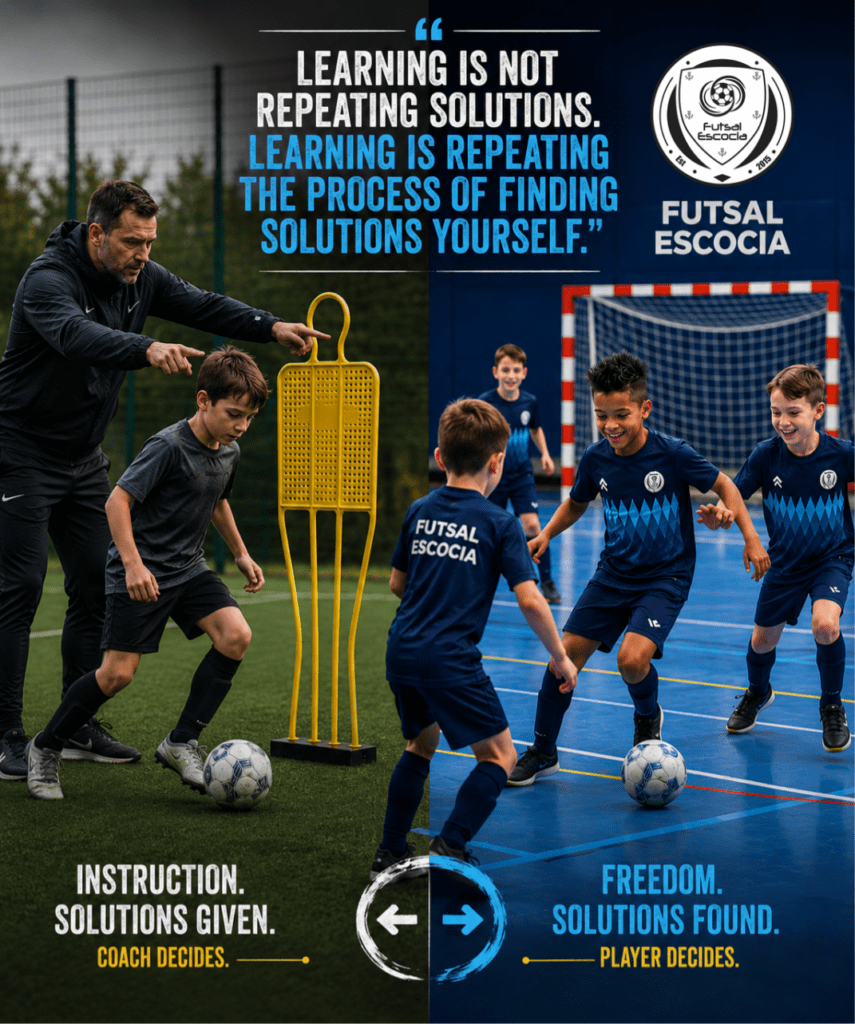
At Futsal Escocia, we share the same ambition as many clubs and academies across the world: to develop players who can think for themselves, solve problems independently, and make good decisions under pressure.
That ambition is reflected in everything we do. We carefully plan our sessions, create age-appropriate learning environments, and provide players with a clear pathway from their first touches on the ball through to advanced and performance-level futsal and football.
However, there is an important question every coach, parent and academy should ask:
Do we leave enough room for players to discover the game for themselves?
Modern youth football can sometimes become over-structured. Every movement is coached, every action analysed, and every solution provided before the player has had the chance to find one on their own.
At Futsal Escocia, we believe that true learning happens when players are given opportunities to think, experiment, fail, adapt and try again.
After all:
Learning is not repeating solutions. Learning is repeating the process of finding solutions yourself.
That is why futsal plays such a central role in our philosophy.
The game constantly presents players with problems to solve. The smaller playing area, reduced time on the ball and increased involvement mean players are continuously scanning, making decisions and adapting to changing situations.
There is no hiding.
There is no waiting for the game to come to you.
Players must think.
Players must solve.
Players must learn.
Research has consistently shown that the most creative players often spend more time in environments that encourage exploration, improvisation and independent decision-making. Historically this happened in the streets, parks and playgrounds. Today, those opportunities are becoming increasingly rare.
Our role as coaches is not to replace those experiences with endless instruction.
Our role is to recreate them.
This is why our sessions are built around games, challenges and realistic situations rather than endless lines, isolated drills or rehearsed patterns. We want players to experience football and futsal as a game first and a lesson second.
Players are not machines that can be programmed with the correct answer.
They are complex individuals who learn through interaction with teammates, opponents and the environment around them.
The best development environments do not simply teach players what to think.
They teach players how to think.
Of course, structure is important. Good coaching provides guidance, support and direction. Without it, development can become random and inconsistent. But when structure becomes too dominant, it can suppress the very qualities we are trying to develop: creativity, curiosity, confidence and courage.
The challenge is finding the balance.
At Futsal Escocia, we see the coach less as an instructor delivering answers and more as a facilitator creating opportunities
We provide the environment.
We ask the questions.
We create the challenges.
The players discover the solutions.
That approach requires trust.
Trust in the player.
Trust in the process.
Trust in the game.
Because it is often in those unpredictable moments—the moments when players are forced to think for themselves—that the greatest learning takes place.
The future stars of the game will not emerge because they memorised every solution.
They will emerge because they developed the confidence and intelligence to create their own.
And that is why, at Futsal Escocia, we remain committed to our philosophy of:
Developing Players Through Small Sided Games.
Not by giving players all the answers.
But by helping them learn how to find them.
Russell Taylor
Director & Head Coach
Futsal Escocia